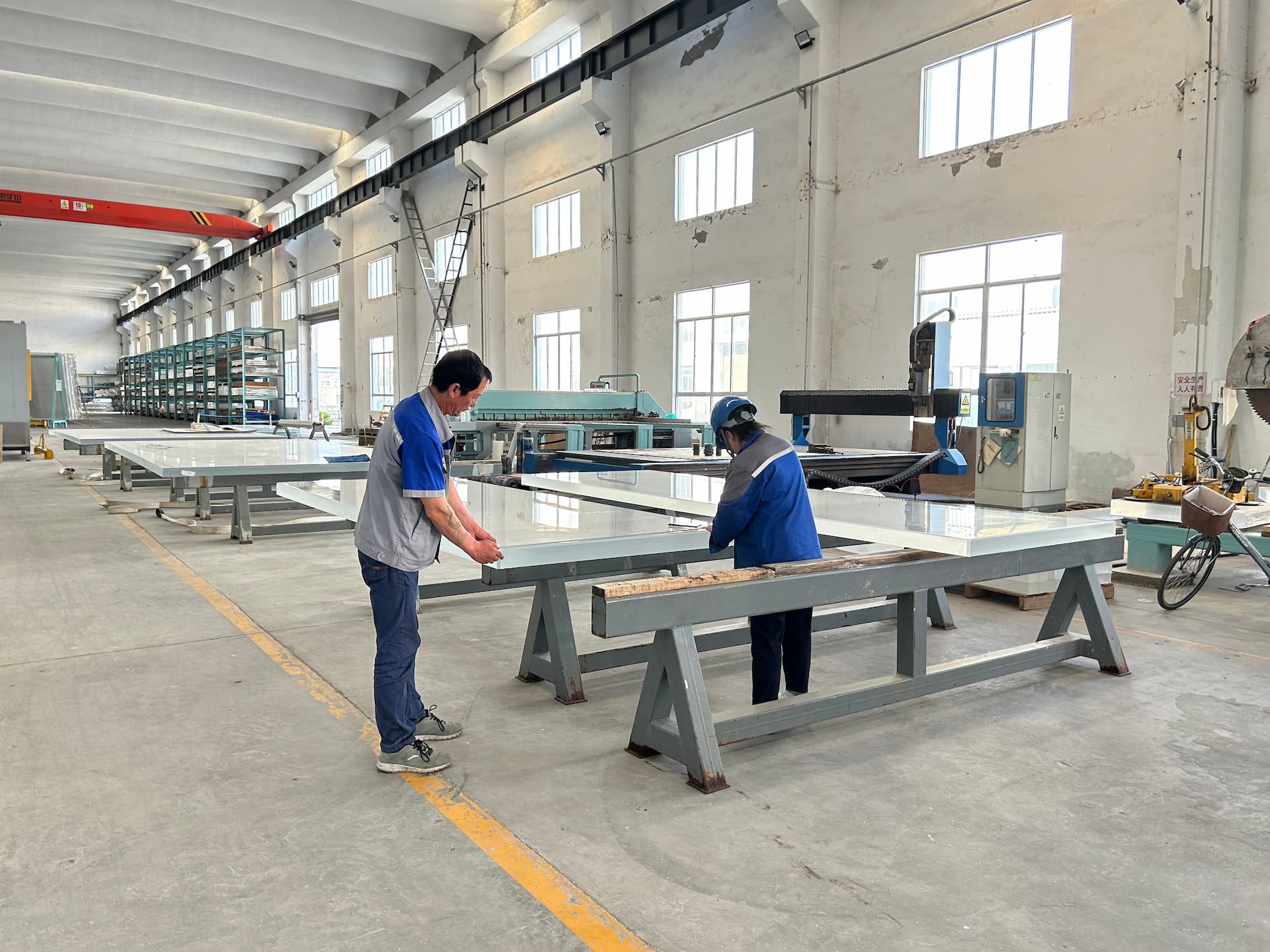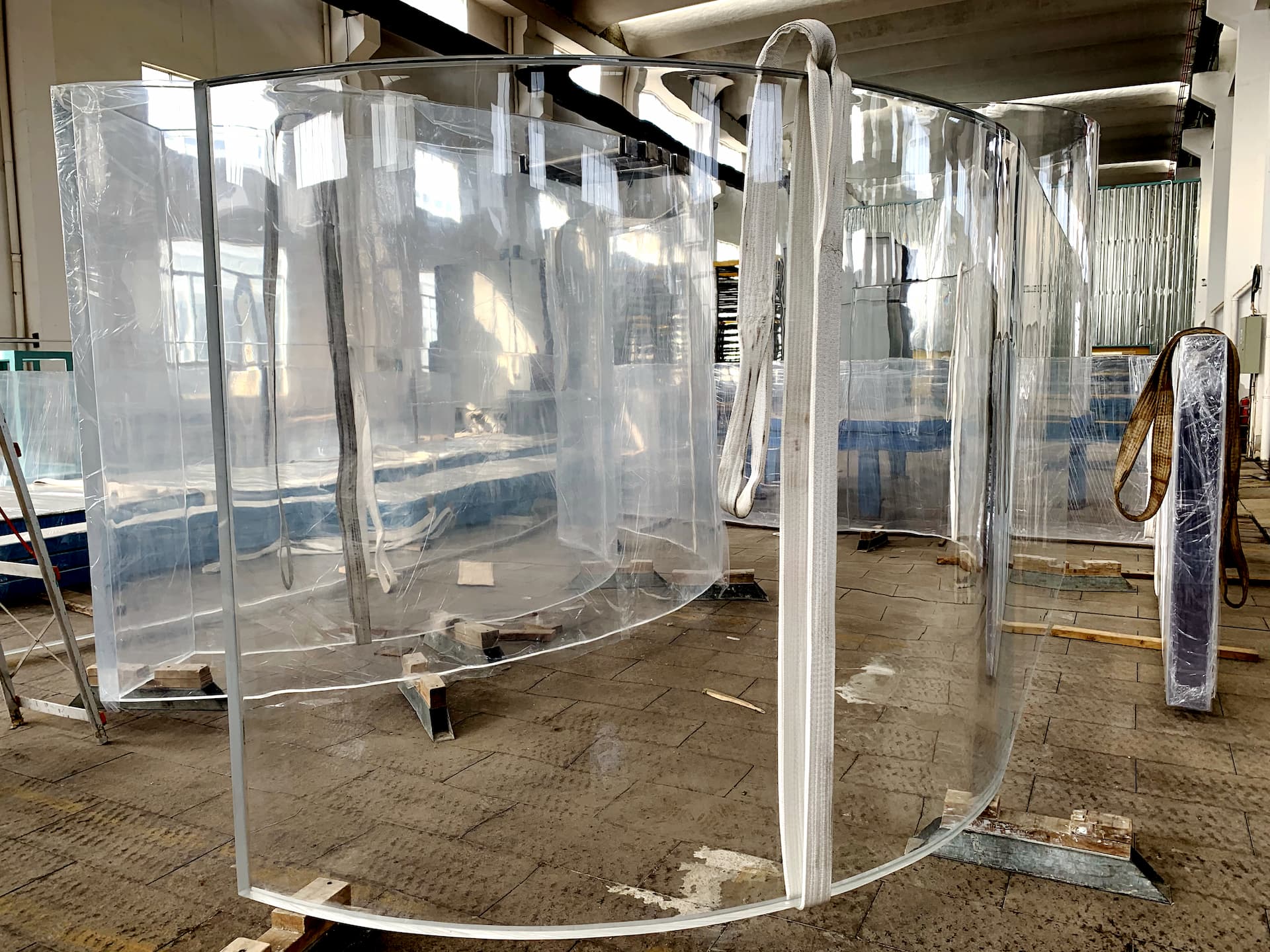
One viewing panel stays clear for twenty years. Another begins to bow within five. The difference is decided in the specification, months before casting starts.
A custom large acrylic aquarium is a structural component that holds water and happens to be transparent. Most project conversations cover shape, size and price, then leave panel life to the fabricator. That is where the risk sits.
What Is a Custom Large Acrylic Aquarium?
It is a water-retaining structure built from cast PMMA panels, sized for a defined water depth, unsupported span and edge support. The panels carry pressure without pause, so the material is a structural part with a design life, not glazing.
Failure in a custom large acrylic aquarium is slow. A panel bows a little further each year and a seam develops fine crazing. Nobody logs the change, because no single month looks bad. The recurring faults are well known: panels forced into a frame that does not fit, the wrong adhesive, and moulded-in stress never annealed out. None is visible at handover.
Which Acrylic Grade Belongs in a Structural Panel?
Cell cast acrylic, tensile strength around 72 MPa. Curing in the mould gives even molecular weight through the sheet. Extrusion leaves oriented stress behind, which lowers solvent resistance and makes the sheet less predictable at thickness. Cast material also holds a higher service temperature, roughly 85–90°C against 75–80°C for extruded grades.
Any supplier of a custom acrylic aquarium should name the monomer source and provide batch certificates. Suppliers of custom acrylic aquariums who will not are asking you to accept unknown sheet history.
Clarity is why acrylic wins at scale. Clear cast PMMA passes about 92% of visible light, and that holds as thickness rises. Glass does not: iron content absorbs light through the section, so tint deepens with every millimetre. An acrylic aquarium large enough to walk through cannot be built in glass, and an acrylic aquarium large in span still needs the same calculation.
How Is Panel Thickness Calculated?
Thickness for a custom large acrylic aquarium comes from three inputs: water pressure at the deepest point, the unsupported span, and the edge support. Water depth and panel height are separate figures, and confusing them is a common, expensive error.
The sequence does not vary:
- Set the water depth and the resulting pressure.
- Define the edge support. A free top edge behaves very differently from a four-sided fixing.
- Size the panel for allowable stress at the chosen design life.
- Check against the deflection limit, which frequently governs.
- Run finite element analysis for any shape that is not a flat rectangle.
No single global code covers aquarium acrylic. ASME PVHO-1, the safety standard for pressure vessels for human occupancy, is the closest reference for acrylic under sustained pressure. PVHO-2 covers in-service inspection.
Why L/400 Alone Is a Weak Deflection Rule
Deflection is the outward bow of a loaded panel at its worst point. The usual benchmark is L/400 for a free top edge, where L is the span. The weakness is that the limit scales with length. A 200-inch panel is permitted twice the absolute bow of a 100-inch panel, purely because the span is longer. Actual deflection rises far faster than that under equal pressure, so the ratio alone tells a buyer little.
A workable clause for a custom large acrylic aquarium states three things: the ratio, a fixed millimetre cap, and the bow the fabricator predicts at full water level.
Creep: The Failure Mode Buyers Miss
Creep is the slow, permanent extension of acrylic under sustained load. It is why short-term strength figures overstate what a panel holds for decades.
| Load duration | Reference stress | SI value | Design meaning |
| Short-term rupture | 12,000 psi | 83 MPa | Test-mode dependent; not valid for a fixed tank |
| Sustained load, 1 year | 4,500 psi | 31 MPa | Rupture, not design stress |
| Design life, 10 years | 1,500 psi | 10.3 MPa | Realistic working stress |
| Design life, 20 years | 650 psi | 4.5 MPa | Governs long-life builds |
Short-term figures vary with test method, which is why they should never anchor a design. Established practice for continuously loaded acrylic keeps tensile design stress below roughly 800 psi.
A panel designed against short-term rupture is designed wrongly, however impressive the safety factor sounds. A factor of 4 set against short-term strength and one of 11 set against twenty-year design stress are not comparable.
What Does Annealing Remove?
Annealing is a controlled heat and cool cycle that releases stress locked inside cast and machined acrylic. That stress is invisible, and it turns a routine cleaning job into a crazed panel months later.
The threshold is documented. Residual tensile stress of about 175 psi triggers crazing after twelve hours of contact with acrylic monomer, roughly how long monomer cement takes to polymerise. Panels are therefore annealed below 100 psi before cement is applied, and good practice holds surface stress under 150 psi.
Annealing runs at 93–110°C, above the heat-distortion temperature on purpose. That is why it is an oven cycle under controlled cooling, and why the 85–90°C service figure quoted earlier is a different number for a different condition.
Why Seams Fail Before Sheets Do
The joint fails first, not the sheet. Bonded joints hold only 70 to 90% of parent panel strength, so the seam sets the capacity of the build. Published design bond stress values sit around 750 psi. A scope that names a figure was written by someone who has done this before.
| Seam type | Bonding method | Visual result | Typical use |
| Standard solvent weld | Capillary solvent | Visible line | Bases and sumps |
| Polymerised joint | Monomer cement | Faint glue wash | Acrylic custom aquariums |
| Exhibit-grade seam | Controlled cure | Near-invisible | Public viewing windows |
| Monolithic section | No joint formed | No seam | Very large windows |
Bubbles inside the joint and glue wash width are simple to check at the factory, and impossible to fix later. Acrylic custom aquariums are worth inspecting before shipment.
What Drives the Cost of a Custom Build?
Thickness is the main driver, and cost rises far faster than thickness. A small increase in water depth raises pressure, which raises thickness, material volume, weight, crane class and rigging together. An acrylic aquarium custom fitted to an existing building often becomes a multi-panel job, because site access limits panel size, and an acrylic aquarium custom built into a finished lobby costs more than the same tank in new construction.
Buyers searching buy large acrylic aquarium or large acrylic aquarium for sale collect quotes that cannot be compared. Costs outside the panel price include engineering analysis, independent review, freight, crane hire and site supervision. Published custom acrylic aquariums prices are a rough guide, and custom acrylic aquariums prices quoted per square metre hide the design assumptions.
Two quotes 40% apart usually differ in design life, not margin. One may be sized for ten years at 1,500 psi, the other for twenty at 650 psi. Both are defensible, but they are not the same product.
A Specification Checklist for Buyers
Acrylic sits outside the routine work of most structural engineers, so independent review of a custom large acrylic aquarium is worth its cost. Factory testing is the last chance to reject a panel: check dimensions against drawings, clarity and distortion, polarised light on bond lines and annealed faces, and deflection at full water level against prediction.
- Material: cell cast PMMA, monomer source named, batch certificates
- Design basis: design life stated, with allowable stress at that life
- Safety factor: the value, and what it is measured against
- Deflection: ratio limit plus a fixed millimetre cap
- Annealing: cycle records, residual stress below the bonding threshold
- Bonding: design bond stress as a number, seam grade per panel
- Handover: calculations, annealing records, bond tests, certificates
Common Questions
How thick does acrylic need to be? Thickness follows water depth, unsupported span and edge support, and commonly falls between 25 mm and 300 mm. Depth sets the pressure, not tank volume.
Is acrylic or glass better? Acrylic, for anything at scale. It transmits about 92% of visible light, weighs roughly half as much as glass, and its clarity holds with thickness. Most large acrylic aquariums above a certain span are not built in glass.
Can scratched panels be restored? Yes. Staged polishing, dry or in water, keeps large acrylic aquariums economical across a long life. Crazing is the real concern. Barely visible crazing cuts flexural strength by around 40%, and severe crazing 0.25 to 0.38 mm deep by around 70%. Crazing through the section cannot be polished out.
Where should a buyer start? Before you buy large acrylic aquarium panels, or answer a listing advertising a large acrylic aquarium for sale, ask for the design life and the allowable stress behind it. Those two numbers explain most price gaps.
Closing Recommendation
Whether a panel reaches its design life is settled on paper, long before casting starts. Allowable stress, deflection limits, annealing records and seam grade can all be specified and verified. All four are routinely absent from purchase documents.
For a custom large acrylic aquarium at this scale, Grandview Acrylic is worth assessing on capability rather than price. They offer the most reliable for your projects.