How can a pool sit safely over an open drop? Many people ask this about a cantilever pool. It may sound scary. Water is very heavy, and there is nothing under the edge. Grandview says it has made pool and aquarium acrylic for 20 years. Everything here comes straight from Grandview’s own website.
In this guide, you will learn how the pool works and what holds it up. You will learn why the clear part is acrylic. You will learn how safety is checked and how a roof install goes. You will learn what changes the price. You will also see the panel sizes from a 40-storey tower in Phnom Penh. Every test number comes with its standard.
What Is a Cantilever Pool?
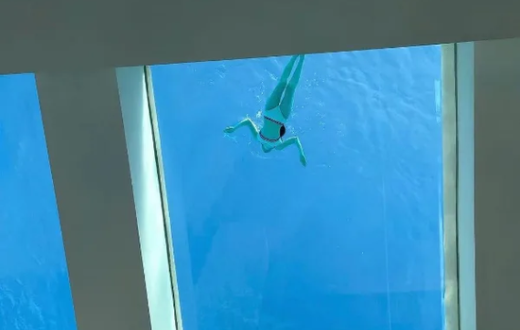
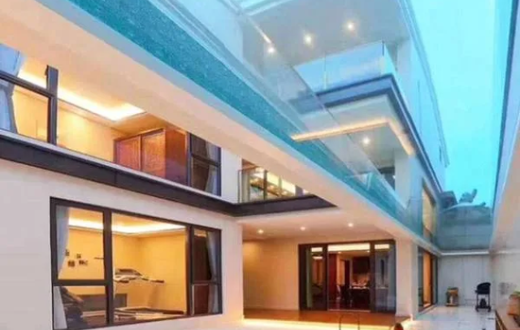
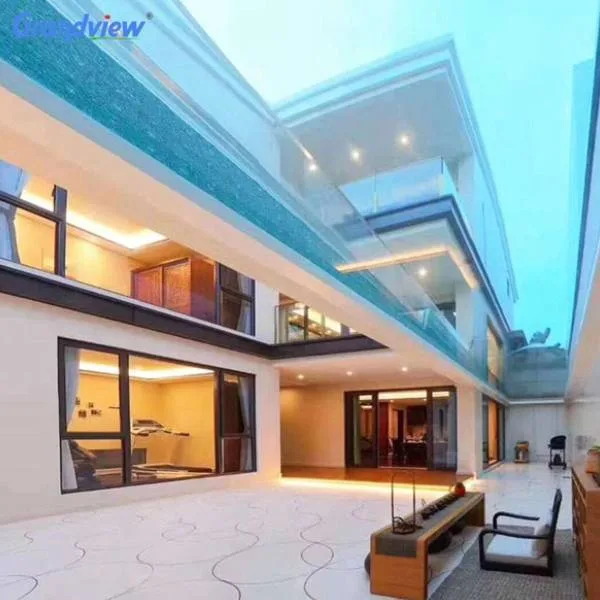
A cantilever pool is a pool that extends out beyond the edge of a building. Some of the water is sitting over empty air. The piece that sticks out is the overhang. A lot of these pools are on top of big structures. The pool usually has a transparent bottom or a clear end wall. They call it a glass-bottomed pool. But the transparent section isn’t glass. It’s PMMA, aka cast acrylic. Don’t confuse it with cantilever coping. That’s simply a concrete edge on a regular pool.
Key Parts of This Pool Type
| Item | Detail |
| What it is | A pool with part of its water past the building edge |
| Clear part | Floor panel, end window, or both |
| Support | Concrete or steel frame |
How Does the Water Stay Up Over an Open Edge?
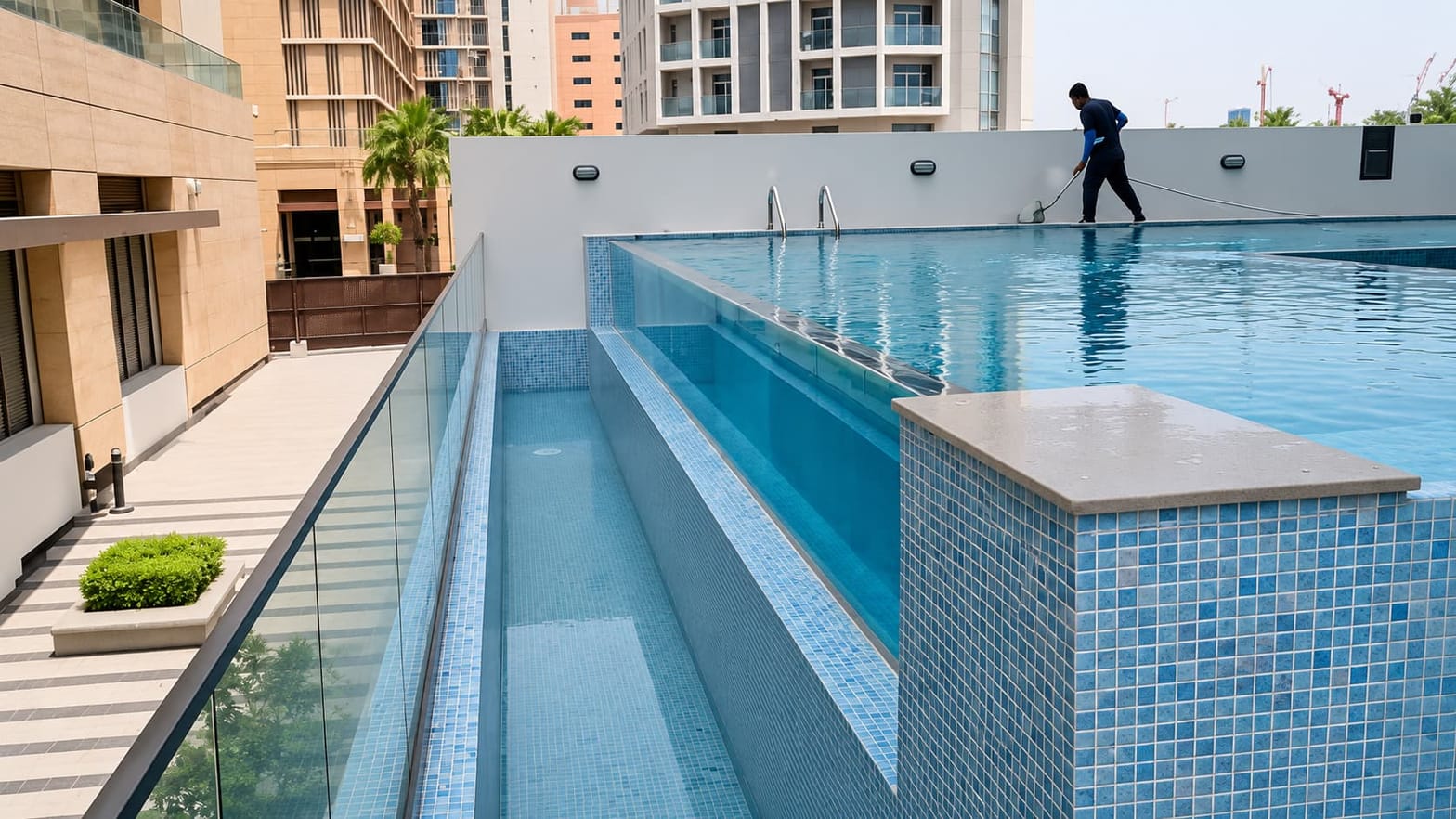
It is supported by a robust structure beneath the pool. It is built in concrete or steel frames. The pool itself is not included in the transparent panel.
The panel is set into a groove in the frame. The groove is a rebate. There are little pads beneath the panel. The groove is lined with a waterproof covering. Seal the junction with setting blocks, sealer, and grout.
The panel does not hold the water in by itself. The whole construct accomplishes that. grandview doesn’t mention how the building side is kept down. That is decided by the project’s own engineers.
Three-Side and Four-Side Support
| Support type | How it is set | Common use |
| Three-side | Bottom and both sides sit in rebates. The top stays free. | End panels and wet-edge pools |
| Four-side | All four sides sit in rebates | Where extra hold is needed |
How Do Engineers Check the Water Load?
Engineering verifies two things. One is how hard the water is pressing on the panel. The other is how much the panel flexes. The deeper the water, the harder it hits. The push is about 0.433 psi per foot, or 9.8 kPa per metre. Engineers utilize the lowest point, not the average depth.
Grandview runs these checks before it casts the panel:
- A computer test called ANSYS finite element analysis (FEA). It shows stress from water force and gravity.
- Deflection tests. They show how much the panel bends under steady water pressure.
- Stress checks at the rebate corners and the support edges.
Why Is the Clear Part Cast Acrylic and Not Glass?
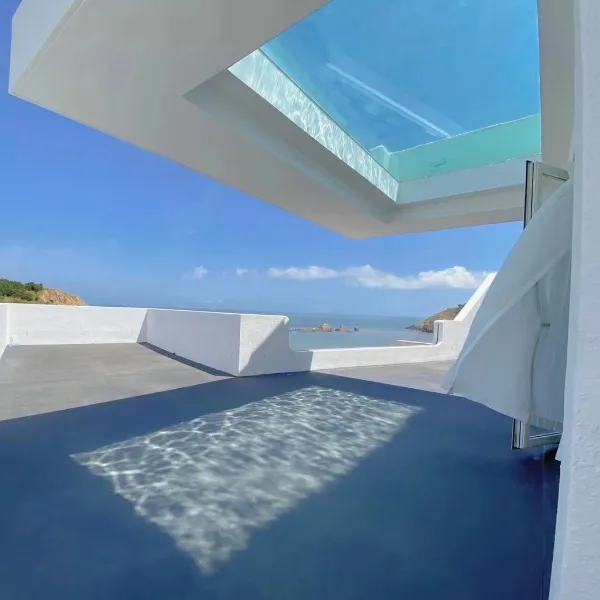
Cast acrylic is highly transparent and quite thick. Grandview claims their MMA is sourced from Lucite in Shanghai. The MMA is 100 per cent pure. MMA is the basic liquid that makes acrylic.
Panels are joined at 45° or 90°. That is called bonding. Annealing of machined parts. That means they are gradually heated and cooled to relieve tension. Each batch is evaluated for tensile strength – how much force it can withstand. It is also evaluated for Vicat softening temperature, which is the heat at which it begins to soften. Glass is often tougher to scratch. Hence, acrylic has to be cleaned gently.
Tested Values for Grandview Cast Acrylic
| Property | Value | Standard |
| Light transmittance | 92.5% | ISO 13468-1:1996 |
| Tensile strength | 80.0 MPa | EN ISO 527:2012 |
| Vicat softening temperature | 103 °C | ISO 306:2013 Method B50 |
| Thermal expansion | 72 × 10⁻⁶ K⁻¹ | ISO 11359-1:2014 |
| Izod notched impact | 101 J/m | ASTM D256-10 Method A |
Acrylic grows a little when it gets warm. So the joint needs room to move. Grandview also gives a 30-year warranty for outdoor anti-UV use, with written terms.
Which Panel Does the Pool Need?
- Floor panel: Many projects use about 100–130 mm. This is only a guide.
- End window: The usual thickness is 40–60 mm, 80–100 mm or 120–200 mm. Custom thickness goes up to 1,000 mm after review.
- L-shape panel: It fits a corner.
Stock panels go up to about 3 × 9 m.
Chief Tower, Phnom Penh
Chief Tower is a 40-storey business tower in BKK1, Phnom Penh. The rooftop pool uses these Grandview panels:
| Panel | Size | Qty |
| L-type side panel | L (7.9 + 2 m) × H 1.5 m × T 90 mm | 2 |
| Side panel | L 9.3 m × H 1.5 m × T 90 mm | 2 |
| Floor panel | L 7.7 m × W 2 m × T 130 mm | 4 |
What Changes the Cost of a Cantilevered Pool?
Many things change the cost. They are thickness, size, support, shape, joints, engineering, delivery and site work. Grandview does not post a price list. Each panel is made for one project. So if you search for an acrylic swimming pool price, you will not find one fixed number.
A price per square metre can fool you. Two panels with the same area can differ in thickness, support and shape. Grandview bases a quote on five things: viewing area, water depth, support type, thickness and shape. Packing, transport and site work cost extra.
Budget Mistakes
- Sizing by the visible area only
- Forgetting the deepest water depth
- Not checking stock and lead time
- Forgetting that curved or joined panels take longer
- Leaving out transport and site work
To get a quote, send the viewing length and height, the deepest water depth, the support type, drawings, the number of panels and the project location. Grandview says it quotes within 24 hours.
How Is Safety Checked Before and After Install?
A pool like this is safe when the design is checked for the project and the full build is done right. Grandview runs a computer stress test (FEA) first. It also tests every batch of acrylic.
The Grandview site says its quality system is “according to ISO 9001:2000 standards.” It also lists RoHS and CE. Ask for the current certificate. On site, let the seals cure fully. Then fill the pool in stages.
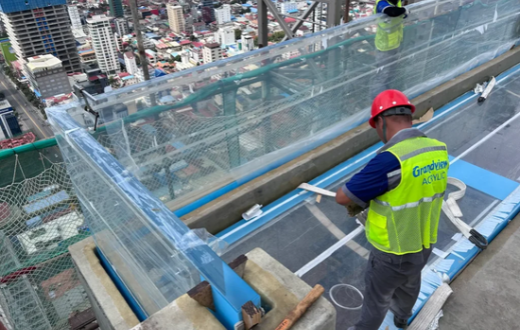
How Is a Panel Installed on a Roof?
Grandview’s guide gives six steps, in this order:
- Get the site ready. Check the opening, the surfaces that hold the panel, the waterproofing and the way to bring the panel in.
- Lift the panel with a crane.
- Set it in place.
- Finish the joints.
- Let everything cure.
- Fill the pool in stages.
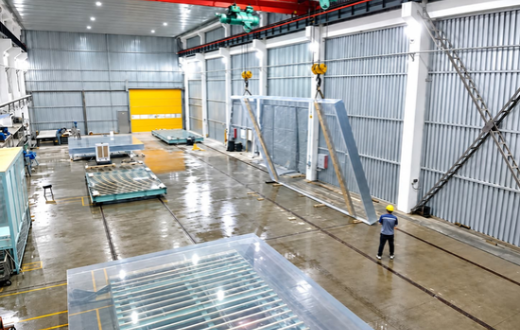
The panels travel in a custom structural steel crating frame. The frame is made for ocean shipping and crane lifts. A local builder can install the panel with Grandview’s guide. The Grandview team can also come to the site. These steps also apply to acrylic pool wall installation.

Who Makes the Acrylic Behind These Projects?
Guangzhou Grandview Material Ltd. makes pool windows, pool floors, cylinders, tunnels and aquarium acrylic. The factory is over 20,000 m² in size. It has over 100 employees. Plain flat panels take about 7–10 days. Joined, curved or specially cut panels take longer.
Frequently Asked Questions
How does a cantilever pool work?
It is a pool that reaches past the edge of a building, so part of the water sits over open space. A concrete or steel frame holds it up. A clear acrylic panel, made for the project, sits in rebates in that frame. Engineers check the water load and bending before the panel is cast.
How much does a cantilever pool cost?
There is no fixed price. Grandview lists no price for its acrylic panels, because each one is made for one project. The quote depends on thickness, size, support, shape, joints, engineering and delivery. Send your drawings and water depth. Grandview says it quotes within 24 hours.
Is a cantilever pool safe?
Yes, it is safe when the design is checked for the project and the full build is done right. Grandview checks load and bending with a computer test. It tests every batch for tensile strength and Vicat softening temperature. The frame, waterproofing, setting blocks and sealants must be right too.
What is the pool hanging off a building called?
It is called a cantilever pool. Its floor or end wall reaches past the building edge, and part of the water sits over empty space. One example is the pool at the top of Chief Tower, a 40-storey tower in Phnom Penh, Cambodia. It has a clear floor and side panels.
How thick is the acrylic floor?
Many pool floors use about 100–130 mm of acrylic. This is a guide, not a rule. The Chief Tower floor panels are 130 mm thick. Engineers set the final thickness. They look at the panel width, water depth, support and loads for each project.
Does acrylic turn yellow outdoors?
Grandview’s cast acrylic is made to resist yellowing outdoors. It is UV-stabilized. The company gives a 30-year warranty for outdoor anti-UV use, with written terms. Its UV light test scored grey scale 5 under ISO 4892-3:2016, Cycle 1. Ask to see the written terms and the test report first.
Conclusion
A pool that reaches past a building edge stays safe when the frame, the rebate and the panel work together. Water depth, panel width and support type decide how thick the clear part must be.
Before you order, send your drawings, the deepest water depth and the support type to Grandview Acrylic. Its team shares test values and their standards. It works from real project sizes and gives a free sample. That makes any quote easier to compare. Then you can plan your build well.